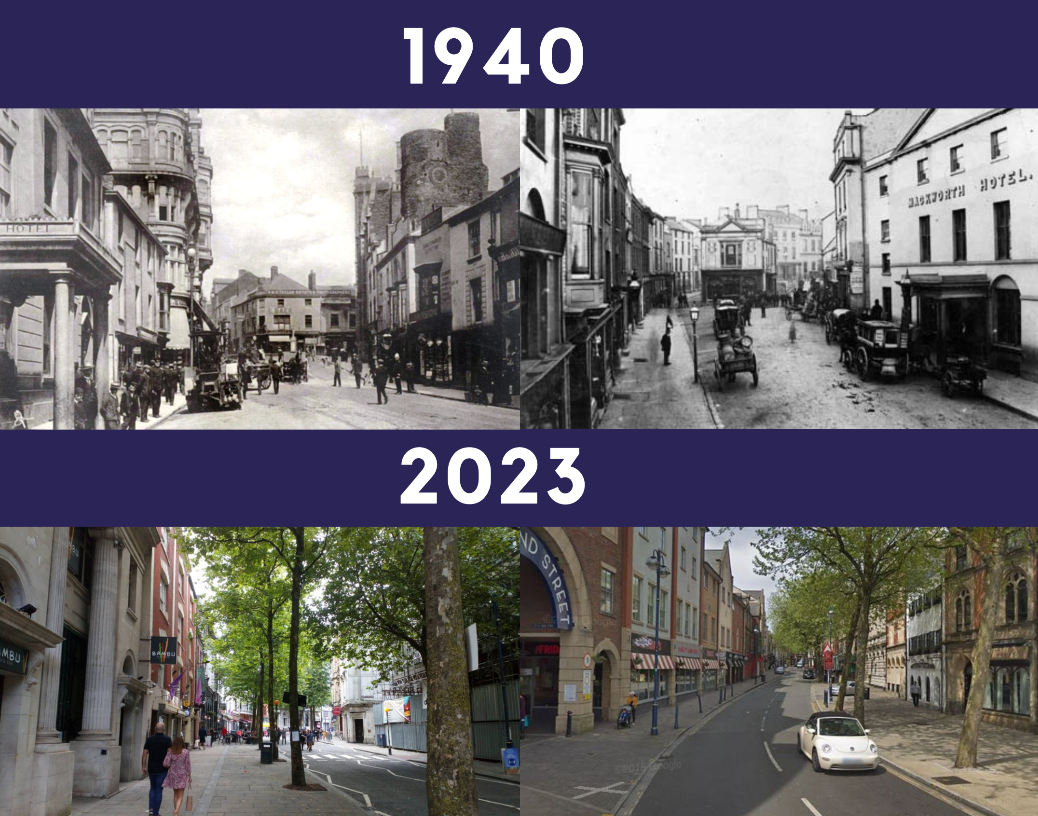
Wind Street 1940-2023
May 16, 2023

Ever wondered about the history of Wind Street?
T
o walk down Swansea’s Wind Street is to follow a route people have trod for the best part of 1,000 years. These days it may have a reputation for its lively nightlife and a kebab on the way home, but over the centuries the street has had many lives, and has changed as Swansea has changed. When you are on Wind Street, you are in the heart of what Swansea was. The origins of the town are undocumented, though one popular theory holds that it was established as a trading post by the Vikings.
By 1100 a Norman castle had been built at the northern end of Wind Street, roughly where the Castle Buildings - with its mix of cafes, shops and flats - is today, and coins soon started appearing on coins, suggesting their was a mint in the settlement.
By the 1500s Wind Street was also home to a busy weekly market which took place in the area near the castle - it’s likely people would have come from all over Gower and beyond to buy and sell goods, and to meet. Ale houses would have followed.
Into the 18th Century the population of Swansea was likely to be no more than 2,000 souls, but as the settlement became more wealthy so did Wind Street.
The commercial development of Wind Street continued into the 19th Century, and by 1854 five of Swansea’s 12 clock and nautical timepiece-making businesses were located on the street, along with banks, accountants and other services needed to support a busy port town. Businesses such as chemists were also trading on the street - in 1888 records show a pharmacist, J Atkins, selling a “blood purifier” which was claimed to banish the pollutants responsible for cancer, gout, distemper, scrofula and many other ailments. At 2s 6d per bottle, it sounds like quite a bargain. As Swansea grew wealthy on its metal-working industries, banks continued to open there, being joined by hotels - including Metropole and the original Mackworth - and exclusive clubs, and later the town’s head Post Office, which still stands today as the Idols bar.
Into the 1920s and Wind Street was continuing to boom, and by the end of the decade Ben Evans boasted 38 departments providing everything from ladies’ fashions, home furnishings and sporting goods, to a restaurant, and even a funeral services.
Well into the 1990s banks were still a prominent feature of life on the street, but as they closed a new kind of business moved in. It was hoped the street might become a “cafe quarter” for the city, but in the end bars and clubs came to dominate. There is currently talk of pedestrianising the street on a permanent basis to make it more people-friendly.
Wind Street is now part of the “night-time economy” of the city offering everything from kebabs to cocktails, pizzas to pints. And it still attracts people from far and wide, as it has done for hundreds of years.
By 1100 a Norman castle had been built at the northern end of Wind Street, roughly where the Castle Buildings - with its mix of cafes, shops and flats - is today, and coins soon started appearing on coins, suggesting their was a mint in the settlement.
By the 1500s Wind Street was also home to a busy weekly market which took place in the area near the castle - it’s likely people would have come from all over Gower and beyond to buy and sell goods, and to meet. Ale houses would have followed.
Into the 18th Century the population of Swansea was likely to be no more than 2,000 souls, but as the settlement became more wealthy so did Wind Street.
The commercial development of Wind Street continued into the 19th Century, and by 1854 five of Swansea’s 12 clock and nautical timepiece-making businesses were located on the street, along with banks, accountants and other services needed to support a busy port town. Businesses such as chemists were also trading on the street - in 1888 records show a pharmacist, J Atkins, selling a “blood purifier” which was claimed to banish the pollutants responsible for cancer, gout, distemper, scrofula and many other ailments. At 2s 6d per bottle, it sounds like quite a bargain. As Swansea grew wealthy on its metal-working industries, banks continued to open there, being joined by hotels - including Metropole and the original Mackworth - and exclusive clubs, and later the town’s head Post Office, which still stands today as the Idols bar.
Into the 1920s and Wind Street was continuing to boom, and by the end of the decade Ben Evans boasted 38 departments providing everything from ladies’ fashions, home furnishings and sporting goods, to a restaurant, and even a funeral services.
Well into the 1990s banks were still a prominent feature of life on the street, but as they closed a new kind of business moved in. It was hoped the street might become a “cafe quarter” for the city, but in the end bars and clubs came to dominate. There is currently talk of pedestrianising the street on a permanent basis to make it more people-friendly.
Wind Street is now part of the “night-time economy” of the city offering everything from kebabs to cocktails, pizzas to pints. And it still attracts people from far and wide, as it has done for hundreds of years.

By Neil Kinnerly
•
October 31, 2025
Halloween is nearly here and it’s always a good time to add a little spooky fun to your day, whether you’re hanging out with friends, getting your place ready, or just enjoying the autumn vibes. Before you dive into the celebrations, we thought it would be cool to share some interesting things about Halloween in the UK and some local Swansea stories to get you in the mood. Halloween actually has really old roots here in the UK. It goes back to an ancient Celtic festival called Samhain. People used to celebrate the end of the harvest season and the start of the cold, dark winter. Back then, they believed that the boundary between the living world and the spirit world was thinner around this time of year. Because of that, they thought ghosts and spirits could cross over and roam the earth. It was a time to light bonfires and wear costumes to keep those spirits away. The pumpkin carving tradition that’s so popular today actually started a little differently. In Ireland and Scotland, people used to carve faces into turnips or other root vegetables to scare off wandering spirits. When Irish immigrants came to America, they discovered pumpkins were easier to carve and much bigger, so the jack-o’-lantern as we know it was born. But if you want to keep it authentic, you could always try carving a turnip this Halloween. Trick or treating is another interesting tradition. It didn’t really become popular in the UK until the 1980s. Before that, kids went “guising” which meant dressing up in costumes and going door to door to perform songs or jokes in exchange for treats. It was less about threats and more about entertainment. So when you’re knocking on doors this year, you’re taking part in a tradition that’s only a few decades old here but has deep roots in earlier customs. Swansea itself has plenty of spooky stories and places that make Halloween feel a bit more real. For example, Swansea Castle is said to be haunted, and people have reported strange noises and ghostly sightings there. The Maritime Quarter has its own legends of mysterious figures wandering the docks late at night. If you’re up for a bit of local adventure, grabbing a few friends and exploring some of these spots could be a fun way to get into the Halloween spirit. If you’re staying in your student house, adding some decorations like cobwebs, spooky lights or even a hand-carved pumpkin can transform your place without much effort. You don’t have to go over the top to make it feel festive. And maybe set up a horror movie night with your housemates. Whether you prefer classic chills or silly scary comedies, it’s a great way to relax and have some laughs. One more fun fact - did you know that in some parts of the UK people still follow the old tradition of “snap-apple” at Halloween? It’s a game where apples are hung from a string and you try to bite one without using your hands. It’s messy but a good laugh with friends. Whether you’re planning to head out, stay in or just enjoy some snacks and spooky stories, it’s a great chance to take a break and have some fun. We hope your Halloween is full of good times, a few surprises and plenty of treats. If you come across any great local events or have some cool decorations or costumes to show off, we’d love to hear from you.